

Stiff Knee After Knee Replacement: Why It Happens and How Long It Lasts
 Dr. Joe Armeli, DPT
Most stiffness after a knee replacement is swelling and muscle guarding, not scar tissue — and the two feel completely different at the end of the motion. Here's how to tell which one you're dealing with, what the timeline honestly looks like, and the point where stiff stops being normal and becomes a stall worth a phone call.
You're doing the exercises. You're walking. And the knee still feels like someone cinched a belt around it and walked away.
Almost every patient who tells me that assumes the answer is scar tissue. For most of them, it isn't. That distinction is worth more to you than anything else on this page, because the fix for a swollen knee and the fix for a scarred one are not the same — and only one of them has a clock on it.
Key Takeaways
| Question | Quick Answer |
|---|---|
| Is stiffness after a knee replacement normal? | Yes. Some tightness through the first three to six months is the rule, not the exception. Stiffness that isn't improving month over month is the part worth acting on. |
| Is it scar tissue? | Usually not. Swelling and quad shutdown account for far more early stiffness than scarring does. The dense scarring that genuinely blocks motion is uncommon — roughly 4% of first-time knee replacements in the largest review to date. |
| How do I tell the difference at home? | Check the end-feel and the elevation response. Swelling gives a soft, springy stop that gains a few degrees after 20 minutes with the leg up. Scar gives an abrupt wall in the same place every time. There's a two-minute self-test below. |
| What bend should I have by when? | Roughly 90° by two weeks, 110° by six weeks, 120°+ by three months. Your surgeon or physical therapist's protocol wins if it says otherwise. |
| What actually loosens a stiff knee? | Frequency, not force. Heel slides at 3 sets of 10, two to four times a day, with 3 to 5 second holds — plus equal attention to straightening, which most people quietly skip. |
| When should I call someone? | If your bend has stayed flat across two to three weeks of honest daily work, or if it keeps sliding backward week over week. One sore morning after a big day is normal and worth watching, not worth a call. Escalation works best early, which is what makes waiting the expensive choice. |
| Where do I learn the exercise itself? | Start with our heel slides guide for technique, then the week-by-week knee bend benchmarks to see where you sit. |
Not sure whether your knee is stalled or just slow?
Get my free 12-week recovery checklist as a printable PDF — the milestones to measure against, week by week. Written by a PT, one email, no spam.
✓ Check your inbox. The checklist is on its way.
What "Stiff" Actually Means After a Knee Replacement
"Stiffness" gets used for two completely different problems, and running them together is why so much advice misses.
The first is a feeling — tightness, a band-like pull across the front, a knee that wants ten minutes of warming up before it cooperates. The second is a measurement — degrees of motion you don't have. They travel together often enough that people assume they're the same thing. They aren't.
I see patients with an excellent measurement and a terrible feeling all the time. Someone bending to 130 degrees who tells me their knee is "so tight" does not have a motion problem. They have a swelling and sensitivity problem, and the fix for that looks nothing like the fix for a knee stuck at 85.
So before anything else: get a number. Measure your bend, or have your physical therapist (PT) measure it, and write it down with the date. Our week-by-week knee bend guide covers how to measure at home. A feeling you can't track will convince you nothing is changing. A number usually proves otherwise.
The direction almost nobody checks
Nearly every article about stiffness talks only about bending. But the stiffness that does the most quiet damage to how you walk is losing the last few degrees of straightening.
Ten degrees short of straight means your quad is working on every single step. Your stride shortens. Your hip and low back start covering for it, and a few weeks later you have new back ache that has nothing to do with your back.
This shows up in how researchers define the problem, too. In a 2019 review of 35 studies covering 48,873 first-time knee replacements, 63% of the studies defined stiffness as a bend under 90° or a flexion contracture greater than 5° at six to twelve weeks (Tibbo et al., JBJS 2019). Losing five degrees of straightening counts as stiffness in the literature. It should count in your home program too.
If your knee feels tight when you stand, and you've picked up a limp, check your extension before you spend another month chasing flexion. Heel slides won't fix it — they address bending only. A knee that won't straighten needs dedicated extension work, with the heel propped and nothing under the knee.
For the bend
Heel Slide Board

A heel that grabs on a sheet or carpet loses you the end of every rep — the degrees you are actually trying to win. This gives it a surface that glides.
Shop the Board →For the straightening
KneEXT Roller

The heel cut-out holds your ankle up with nothing under the knee, so gravity can work on your last few degrees for long enough to count.
Shop the KneEXT →Neither is required — a plastic bag on any smooth surface and a rolled towel under the ankle do the same two jobs. Keep to the bed or couch until your PT clears you for floor transfers, which is usually around two months. They make them easier to do every day, which is the part that decides the outcome.
Swelling Tightness vs Scar-Tissue Stiffness: A Two-Minute Self-Test
This is the part no one puts in writing, and it's the most useful thing I can give you. Three checks, two minutes, no equipment.
1. The end-feel test
Bend the knee slowly to the point where it stops. Then, gently, ask for one more degree and pay attention to how it refuses.
Soft and springy — it gives a few millimetres, feels boggy or full, maybe pulses back at you a little. That's fluid and muscle guarding. The joint has room; something is occupying it.
Hard and abrupt — it stops like a door hitting a frame, in the same spot every time, with nothing behind it. That's a mechanical block.
Most knees in the first two months are soft-and-springy. That is good news, and it's the finding that tells you your daily work is aimed at the right target.
2. The elevation test
Measure your bend. Then lie down with the leg elevated above heart height for 20 to 30 minutes — ankle propped, nothing under the knee. Measure again.
A swollen knee will usually pick up a few degrees. A knee whose limit is structural won't move at all. Same knee, twenty minutes apart, and you've learned more than an afternoon of reading will tell you.
3. The active-versus-passive gap
Slide your heel back as far as your own muscles take it. Note where it stops. Now use your hands or a strap to pull it further, gently, and note that number.
A large gap between the two — where assistance buys you a lot more range — points at quad shutdown and guarding, not scar. The joint clearly moves; your muscles just aren't driving it there yet. That's a strength and confidence problem with a much better prognosis, and it's exactly what active-assisted work is for. Our guide to heel slides with a strap covers the technique.
A small gap — assistance buys you almost nothing — means the limit is in the joint, not the muscle.
None of this replaces your surgeon's assessment. It tells you what to say when you call, which is a different and genuinely useful thing. "My knee is stiff" gets you reassurance. "My bend hasn't moved in ten days, the end-feel is hard, and elevating it doesn't change the number" gets you an appointment.
The Stiffness Timeline: Normal Stiff vs Stalled Stiff
Here's the shape of a normal recovery, and what the same week looks like when something needs attention.
| When | Normal stiff | Worth a closer look |
|---|---|---|
| Weeks 1–2 | Tight and swollen most of the day. Working toward about 90° of bend. Warming up takes a while. | Bend that keeps sliding backward week over week, or a knee that's hot, increasingly red, and feverish. |
| Weeks 3–6 | Bend climbing from 90° toward 105–110°. Stiffest first thing in the morning and after sitting. | No measurable change across two to three weeks of honest daily work, or a hard end-feel that isn't softening. |
| Weeks 7–12 | 110° heading to 120°+. Stiffness now episodic — it follows big days rather than sitting on you constantly. | Still under about 90° at six to eight weeks. This is the window where escalation options work best. |
| Months 3–12 | The tight-band feeling fading gradually. Most knees settle around 117–122° by a year. | Motion clearly lost compared with where you were at three months. |
Two things about that table are worth saying out loud.
Recovery isn't linear. A flat week, or a week where the number drops two degrees after a big day, is part of the curve and not a verdict. Swelling rebounds, numbers dip, then jump. What matters is the trend across three or four weeks, which is exactly why I keep asking you to write the number down.
Bending and straightening improve on different schedules. In one small study that measured 39 knees with a goniometer for a full year after surgery, most of the average gain in bending was in by around three months and most of the average gain in straightening by around six (Mutsuzaki et al., J Rural Med 2017). That's a group average curve, not a deadline for your knee — but it does explain why straightening can keep improving for months after your bend has levelled off. That is not a reason to put it off: getting the knee fully straight is the single highest priority of the early weeks, because the window for it closes sooner than the one for bending.
Why mornings are the worst
Almost everyone asks about this, and almost no one writes it down.
Overnight, you're still. Fluid settles into the joint and the soft tissue around it, and you've spent seven hours in roughly one position. Then you stand up on a knee that's full and hasn't moved, and it feels like it belongs to someone else.
Morning stiffness that melts over 10 to 20 minutes of moving around is the classic fluid-and-stillness pattern. It is not a sign your scar tissue is winning. The same thing after sitting through a film is the same mechanism on a shorter clock. Stiffness that doesn't ease with movement is the version worth mentioning to your PT.
Arthrofibrosis: When Scar Tissue Is the Actual Diagnosis
Sometimes it genuinely is the scar tissue. That condition has a name, and it's worth understanding properly rather than as a vague threat.
Arthrofibrosis is what happens when wound healing overshoots. It's characterised by excessive proliferation of scar tissue during an impaired healing response, and the stiffness it causes produces real deficits in everyday activities (Cheuy et al., J Arthroplasty 2017). A more recent review frames it as an exaggerated immune response to a pro-inflammatory insult, leading to fibrosis around the joint and symptomatic stiffness (Lee et al., Sports Med Arthrosc Rev 2022).
Read that mechanism again, because it changes what you should do. The driver is inflammation. Which means the knee you keep angry with grinding, maximal-effort stretching every day is the knee you are feeding.
How common is it, really
Less common than the internet suggests.
The number worth knowing
In a 2019 review of 35 studies covering 48,873 first-time knee replacements, researchers looked at one specific kind of lasting stiffness — a knee still bending under about 90° more than twelve weeks after surgery, with no other cause found — and that was the problem in roughly 4% of knees. It was more common in women than men (3% versus 1%) and in patients with a BMI of 30 or above compared with under 30 (5% versus 2%).
Source: Tibbo et al., Acquired Idiopathic Stiffness After Total Knee Arthroplasty, JBJS 2019
One caution about that 90° figure: it's a research definition, used to decide who counts as a study patient. If you're at 88 degrees at week thirteen, you have not been diagnosed with anything. You have a number that's worth a conversation.
What it is not
It is not a punishment for not trying hard enough. The risk factors that show up consistently are largely things you didn't choose. In one registry of 12,735 knee replacements followed for an average of seven years, the factors associated with stiffness and manipulation included younger age, longer tourniquet time, general anesthesia, and diabetes (Owen et al., J Arthroplasty 2021). In a separate series, a history of previous surgery on that same knee, less motion before surgery, and less motion at the time of hospital discharge were each independently associated with needing a manipulation later (Freccero et al., JB JS Open Access 2022).
Age. Anesthesia type. Diabetes. Where your knee started. None of that is effort.
What Actually Loosens a Stiff Knee
The short version: frequency beats force, and the thing that limits frequency is almost never motivation.
Dose, honestly
Heel slides, 3 sets of 10, two to four sessions a day, with a 3 to 5 second hold at the end of each rep and about four seconds to travel there. Rest a minute between sets. First thing in the morning is the most valuable session of the day, because that's when the knee is worst and has the most to gain.
After the first two weeks, aim for a strong stretch — up to four or five points above your baseline pain out of ten — that settles before your next session. In weeks one and two keep it conservative: discomfort is fine, but sharp pain means stop. Not a nine. A nine buys you nothing but a knee that's angrier tomorrow, and per the mechanism above, an angry knee is the one laying down more scar.
Your PT's specific instructions always win over anything on this page.
The reason two-to-four sessions quietly becomes one
Every article tells you to be consistent. None of them tell you why consistency collapses, so here it is.
On a bedsheet, a carpet, or a couch cushion, your heel doesn't glide — it grabs, stutters, and stops. The last few degrees of every single rep, the degrees that actually matter, never happen. A jerky drag also triggers exactly the protective muscle guarding you're trying to switch off. So the exercise feels pointless, because in a real sense it is, and by day four you're doing one session instead of three and blaming yourself for it.
That is a friction problem wearing a discipline costume.
A Surface That Doesn't Fight You
The fix is any surface smooth enough that your heel travels instead of catching — a plastic bag on a smooth surface works, and so does a proper board. What a board adds is consistency: the same glide every session, and a flat reference you can mark, so week 1 versus week 6 is a measurement rather than a feeling.
The EquipCore Heel Slide Board is a 2.5 lb, 28" × 15" board, designed to sit on a bed or couch early on — and on the floor once your PT has cleared you for floor transfers, typically around the two-month mark — giving the heel a friction-free path through the end of the range where the stretch actually lives.
Shop the Slide Board →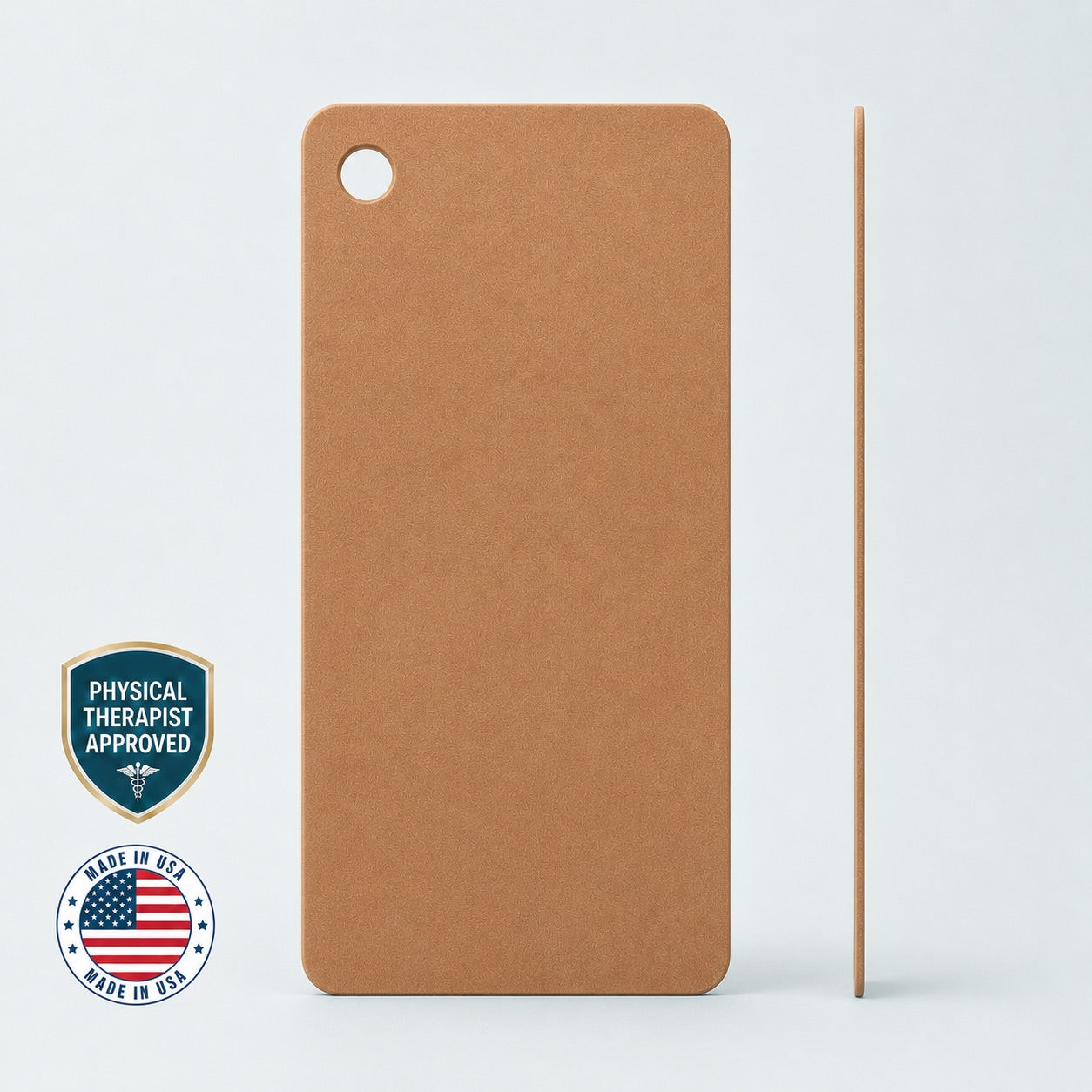
Active beats passive
Your own muscle contraction does something a machine can't. In a randomised trial comparing active heel-slide exercise plus standard physical therapy against continuous passive motion plus standard therapy, the active group had less pain, better Hospital for Special Surgery knee scores, and better sit-to-stand, stair and timed-up-and-go performance at discharge, achieved a straight leg raise sooner, and had better knee position sense at discharge and at three months (Eymir et al., Knee Surg Sports Traumatol Arthrosc 2021). The authors recommended active exercise as the first choice over the passive machine.
Which is a research way of saying: the work only counts if the knee is doing it.
Assistance for the last few degrees
Once your own muscles stop being able to drag the heel further, you need something adding overpressure — that's the point where the work changes, and our flexion guide covers why 90 degrees is where it changes. A strap around the foot, your other leg crossed over the ankle, or your hands. The crossover heel slide is the one I use most for exactly this.
Hands-on work, with a realistic expectation
Manual therapy helps, but probably not in the way you'd assume. In a small randomised trial of 42 patients, adding joint and soft tissue mobilisation to an exercise programme improved pain, function and patient satisfaction more than exercise alone — while the overall group-by-time effect on flexion and extension range of motion was not statistically significant (Karaborklu Argut et al., PM R 2021).
So hands-on work earns its place by making you more comfortable and more functional, which in turn makes you more able to do the exercise that does move the number. It is not a shortcut past the exercise.
Don't forget the other half
Extension work is a separate job with a separate setup: heel propped on a rolled towel, nothing under the knee, and let gravity do the rest. A KneEXT roller with a heel cut-out makes that position easier to hold for the length of time it takes to matter. And never sleep with a pillow under the knee — it feels wonderful and it quietly costs you your straight leg.
What Makes Knee Stiffness Worse
Believing you can break scar tissue up with your hands
This one deserves a plain answer, because the phrase "break up scar tissue" is everywhere and it sets people up to fail.
You do not tear adhesions inside your knee joint by stretching harder, rubbing at the incision, or rolling something over it. Tissue remodels — slowly, in response to repeated, tolerable load applied over weeks. It does not snap. Anyone promising that a device or a technique will break it up is describing something that doesn't happen at home.
What does respond to hands-on work is the surface layer: the incision, the fat pad, and the sliding of skin and soft tissue over the joint. That tight band across the front of the knee that so many patients describe is usually this — a surface and sensitivity problem, not a deep structural one — and scar massage genuinely helps it once your surgeon confirms the incision is fully healed.
Grinding harder on a bad day
Given that the underlying mechanism is inflammatory, the maximal-effort, teeth-gritted stretch is not a neutral choice. Supervised physical therapy remains the first line of defence against arthrofibrosis, and its effectiveness depends on the timing, intensity and progression of the programme relative to what the patient can tolerate (Cheuy et al., J Arthroplasty 2017). Intensity that outruns tolerance isn't dedication. It's a dosing error.
Waiting for the pain to settle before you start
The most expensive mistake on this list. The knee is never going to feel ready. Extension is the range that's hardest to win back if it slides early — flexion is more forgiving, and plenty of people who run behind at first still finish in the typical range — but the window where the strongest interventions work well is measured in weeks, not months either way.
Counting on a CPM machine
If someone has offered you a continuous passive motion machine, temper your expectations. A meta-analysis of 16 trials and 1,224 patients found that neither range of motion nor functional outcomes were improved by CPM after knee replacement, and the authors concluded the evidence was insufficient to support using it routinely (Yang et al., Arch Phys Med Rehabil 2019). It isn't harmful. It just isn't the thing that's going to move your number, and the hours spent in it are hours not spent doing active work.
Only ever bending
Flexion is measurable and satisfying, so it gets all the attention. Extension is neither, so it gets skipped — and it's the one that changes how you walk.
The Fibrotic Healer: Why Pushing Harder Backfires on Some Knees
A minority of knees scar faster and more aggressively than average. Surgeons call these patients fibrotic healers, and if you are one, the standard advice to push through is actively wrong for you.
The tell is a pattern rather than a single session: every time you chase a big stretch, the knee is hotter, fuller and stiffer the next morning, and a week of hard work leaves you with less range than you started. That is not a willpower problem. It's a knee responding to load with inflammation, and inflammation is the raw material the scarring is made from.
For those knees, the prescription inverts. Gentler holds, done more often, beat grinding harder — the same three sets of ten taken at the top of the two-to-four-times-a-day range, calm and never spiking the pain, instead of two heroic sessions that do. Early physical therapy and anti-inflammatory management remain fundamental to avoiding loss of motion, with surgery reserved for knees that don't respond to non-operative measures (Lee et al., Sports Med Arthrosc Rev 2022).
You can't be tested for this in advance. You find out by paying attention to how your knee answers, which is one more reason to write the number down. There's more on the pattern and how to adjust in our guide to knee flexion exercises after knee replacement.
When Stiffness Means It's Time to Escalate
Here's my rule, and it's deliberately simple: if your bend has stayed flat across two to three weeks of consistent, honest daily work, that's the point to call. Not to panic — to call.
Add these to the list of reasons to pick up the phone sooner:
- Your knee is still under about 90 degrees at six to eight weeks.
- The end-feel has gone hard and isn't softening.
- Your bend keeps sliding backward week over week — not one sore morning after a big day, which is normal and worth watching rather than calling about.
- The stiffness is getting worse and is paired with heat, spreading redness or a fever.
That last one isn't a stiffness question at all. A hot, increasingly red knee with a fever, new calf pain or swelling, or chest pain or sudden shortness of breath means call your surgeon the same day — they'll tell you if you need the ER.
The reason I'm insistent about that two-to-three-week rule is that the strongest interventions are time-sensitive. A manipulation under anesthesia (MUA) — a brief procedure where the surgeon bends the knee for you while you're sedated — produced a mean flexion gain of 36.5 degrees when done within twelve weeks of surgery, versus 17 degrees when done later (Issa et al., J Bone Joint Surg Am 2014). Same procedure. Roughly twice the result, decided by the calendar.
Waiting and hoping is the one strategy with a guaranteed cost. If an MUA is a word that's come up in your appointments, or you want to understand what you'd actually be agreeing to, read our full guide to manipulation under anesthesia (MUA) after knee replacement.
One more thing, because the research supports it: patients routinely report that their pain and stiffness concerns were brushed off. If something feels wrong to you, push. You are the only person measuring this knee every day, and "let's watch it" is a decision you're allowed to question — particularly inside that twelve-week window. There's more on auditing the fixables before you escalate in our guide to when recovery stalls and the 12-week window.
Stiffness 1, 2, or 5 Years After Knee Replacement
A lot of people arrive here long past the twelve-week conversation, and almost nothing written about stiffness speaks to them. So, honestly:
A permanently tighter knee than the one you were born with is a normal outcome, not a failure. Most knees settle somewhere around 117 to 122 degrees by a year. That's enough for stairs, chairs, car seats and ordinary life. Level walking takes roughly 60 to 75 degrees of bend; stairs roughly 80 to 90 at every level, including step over step — that progression is driven by quad strength and pain, not by range; sitting in a chair about 90; standing back up without pushing off about 95; and getting into a car 100 to 110. Kneeling and deep squatting are the things most replaced knees don't fully get back.
Startup stiffness that eases within minutes is a feature of the joint, not a warning. Stiff for the first few steps after sitting, then fine, is the pattern I'd expect years out and isn't something to chase.
Motion you have genuinely lost is a different conversation. If you could do something at six months that you can't do now — real, measured degrees gone, not just a feeling — that deserves a surgeon's assessment rather than a harder home program. Late loss of motion has causes worth identifying, and none of them are fixed by stretching more.
I'll be straight about the limits of what's known here: I can tell you what the evidence says about stiffness in the first year in considerable detail, and much less about how much range a knee can regain at the two-year mark. That's a genuine gap in the literature, not something I'm withholding. Which is exactly why the first twelve weeks get the emphasis they do on this site.

Recovering from a knee replacement right now?
Get my 12-week recovery checklist as a free printable PDF. One email. Stick it on the fridge and check off your milestones.
✓ Check your inbox. The checklist is on its way.
Frequently Asked Questions
How long does stiffness last after a total knee replacement?
For most people, noticeable stiffness eases over the first three to six months, and the tight-band feeling fades gradually after that. Some startup stiffness after sitting can persist much longer and is normal. The question that matters more than the calendar is direction: stiffness that improves month over month is on track, and stiffness that hasn't changed across two to three weeks of consistent daily work is worth a call to your physical therapist or surgeon.
How do I know if my stiffness is scar tissue or just swelling?
Check the end-feel and the elevation response. Swelling and muscle guarding give a soft, springy, boggy stop that gives a few millimetres if you ask gently, and a knee that usually picks up a few degrees after 20 to 30 minutes with the leg elevated. Scar tissue gives an abrupt, hard stop in the same place every time that doesn't change with elevation. Most stiffness in the first two months is the soft, springy kind.
How do you break up scar tissue after a knee replacement?
You don't break it up, and any product or technique promising that is describing something that doesn't happen at home. Scar tissue remodels slowly in response to repeated, tolerable loading over weeks — which is what consistent daily range-of-motion work is. Scar massage does genuinely help the surface layer, meaning the incision and the tissue sliding over the joint, once your surgeon confirms the incision has fully healed. The deep adhesions inside the joint are what a manipulation under anesthesia addresses.
What is arthrofibrosis, and how common is it?
Arthrofibrosis is excessive scar tissue forming during an impaired wound-healing response, producing stiffness that limits everyday activities. It is less common than the internet suggests: in a 2019 review of 35 studies covering 48,873 first-time knee replacements, a knee still bending under about 90 degrees more than twelve weeks after surgery with no other cause found was the problem in roughly 4% of knees. It was more common in women than men and in patients with a BMI of 30 or above.
How do I loosen up a stiff knee after a knee replacement?
Frequency beats force. Heel slides at 3 sets of 10, two to four times a day, with a 3 to 5 second hold at the end of each rep, and, once you're past the first two weeks, aiming for a strong stretch up to four or five points above your baseline pain out of ten that settles before the next session — in weeks one and two, discomfort is fine but sharp pain means stop. Do the first session in the morning when the knee is stiffest. Give straightening equal attention, with the heel propped and nothing under the knee. Use a surface smooth enough that your heel glides rather than catches, because a heel that grabs loses you the last few degrees of every rep.
My range of motion is good but my knee still feels tight. Is that normal?
Extremely. A knee at a good number that still feels wrapped in a too-small elastic sleeve is near-universal, and it typically fades over months three to six. If you are bending past 120 degrees and the complaint is the feeling rather than the measurement, you do not have a motion problem to solve — you have swelling, sensitivity and confidence to let settle, and the useful response is to keep moving normally rather than to stretch harder.
Can you overdo exercise or walking after a knee replacement?
Yes, and a minority of knees punish it. The mechanism behind problem scarring is inflammatory, so a knee that is hotter, fuller and stiffer the morning after every hard session is telling you the dose is too high. For those knees, gentler holds done more often beat grinding harder. A strong stretch that settles before your next session is the target; a nine out of ten is not.
When is it too late to do something about a stiff knee replacement?
Sooner is decisively better, but "too late" is rarely absolute. A manipulation under anesthesia performed within twelve weeks of surgery produced a mean flexion gain of 36.5 degrees versus 17 degrees when performed later. If you are months out and stuck, that is still a conversation worth having with your surgeon rather than a door that has closed — but it is a conversation to have now rather than after another season of waiting.
Stiff Is Normal. Stalled Is Not.
Run the end-feel and elevation checks, write the number down, and give it two to three weeks of honest work before you judge it. If the number hasn't moved by then, make the call — early is worth roughly twice as much as late. Our full heel slides guide covers the technique that moves it.
The EquipCore Heel Slide Board gives your heel a surface that glides instead of grabbing — so the last few degrees of every rep actually happen, and two sessions a day stay two sessions a day.
Shop the Heel Slide Board →PT-Designed | Free Shipping | 30-Day Returns
Disclaimer: This guide is for educational purposes and does not replace the advice of your surgeon or physical therapist. Always consult with your medical team before beginning new exercises.
Tell me what you're recovering from and where you're at — I'll point you to the right tool, or tell you honestly if you don't need one yet. Every message comes straight to me, and I read every one personally.