

Knee Manipulation After Knee Replacement (MUA): Timing, Recovery and What the Data Shows
 Dr. Joe Armeli, DPT
A manipulation under anesthesia is not a failure and not a second surgery — it's a short procedure that buys back bending range lost to scar tissue. But it works roughly twice as well inside twelve weeks as it does after, which makes the calendar the most important thing on this page.
If your surgeon has used the phrase "we might need to manipulate it," you're probably reading this at night, on your phone, trying to answer two questions: is this my fault, and how much time do I have?
No, and less than you'd like. Let's go through it properly.
Quick definitions, because they stack up fast. TKR is total knee replacement. ROM is range of motion, measured in degrees of bend. PT is physical therapy or your physical therapist. MUA is manipulation under anesthesia — a brief procedure where the surgeon bends the knee for you while you're sedated, used when rehabilitation alone hasn't achieved adequate motion (Issa et al., J Bone Joint Surg Am 2014).
This page is about the decision. If what you need first is the bigger picture on why the knee got stiff at all, start with our guide to the stiff knee after knee replacement and come back.
Key Takeaways
| Question | Quick Answer |
|---|---|
| How many people need one? | Depends where you look, because hospitals use different thresholds. A national database of 141,016 knee replacements found 4.3% had an MUA within six months. Single-hospital series range from about 2.3% to 8.6%. |
| Does timing really matter? | Substantially. Within twelve weeks: a mean gain of 36.5° and 119° of final motion. Later: 17° gained and 95° final. Same procedure, roughly double the result. |
| Is it ever too late? | Rarely absolute. A 2024 review of 152 late manipulations — from twelve weeks out to beyond a year — found all three timing groups still gained significant motion, averaging around 20°. |
| Can I avoid one? | Sometimes. Consistent daily flexion work inside the first six weeks is the lever you control. Several of the strongest risk factors are not things you chose. |
| Does it hurt afterward? | The procedure itself is done under anesthesia. The days after are sore and swollen, and how sore varies a lot — ask your surgical team what to expect and what pain control you'll have. |
| What decides the result? | What you do in the two weeks afterward. Motion gained in the operating room has to be held onto through therapy, or it closes back down. |
| Where do I learn the exercise? | Our heel slides guide covers the technique, and the knee flexion exercises guide covers what to add past 90°. |
Know what your knee should be doing, week by week
Get my free 12-week recovery checklist as a printable PDF — the milestones to measure against, so a stall is obvious early. Written by a PT, one email, no spam.
✓ Check your inbox. The checklist is on its way.
Is an MUA Actually on the Table for You?
There's no universal rule, and that's worth knowing before you compare yourself to a number you read somewhere. Thresholds are set hospital by hospital.
At one high-volume orthopaedic hospital, the standing protocol was that patients with less than 90 degrees of flexion at six weeks underwent a closed manipulation (Freccero et al., JB JS Open Access 2022). Another series used a much stricter definition — a flexion contracture greater than 15 degrees and/or flexion under 75 degrees — before calling a knee stiff at all (Archunan et al., Cureus 2021).
Those are two different bars, and a knee that triggers intervention at one hospital would be watched at the other. So the useful question isn't "am I below the number." It's this:
- Where is your bend, in degrees, measured — not estimated?
- Has it moved across the last two to three weeks of consistent daily work?
- How many weeks post-op are you?
Those three answers are what your surgeon needs, and the third one is the one with a clock on it. A knee at 85 degrees at week five is under the typical range for that week, and four degrees is slower than the five to ten a week most knees pick up before week six — that's a call worth making now, while the window is wide open, rather than at week nine. A knee at 85 degrees at week nine that hasn't moved in a fortnight is a different conversation.
How Often Does This Actually Happen?
More often than people expect, and less often than the forums suggest.
The number worth knowing
In a national database of 141,016 knee replacements, 4.3% of patients required a manipulation under anesthesia within six months of surgery. Single-institution series report anywhere from 2.29% to 8.6%, depending largely on the threshold that hospital uses to decide a knee is stiff.
Source: Werner et al., J Arthroplasty 2015; Archunan et al., Cureus 2021; Freccero et al., JB JS Open Access 2022
Put another way: somewhere around one in twenty to one in twelve. You are not an outlier, and you are not the only person your surgeon has had this conversation with this month.
Who ends up needing one
The risk factors are mostly not things you decided. In that national database, being under 50, being 50 to 65, female sex, and smoking among patients under 65 were all associated with higher manipulation rates (Werner et al., J Arthroplasty 2015). In a separate series, a history of previous surgery on that same knee, less motion before surgery, and less motion at the time of hospital discharge were each independently associated with needing a manipulation later (Freccero et al., JB JS Open Access 2022).
Age. Sex. The knee you walked in with. Where your motion was the day you left hospital. Read that list again and notice how little of it is effort — because the single most common thing patients say to me in this situation is "I should have worked harder."
How to Lower the Odds While the Window Is Still Open
You can't change your age or the motion you had going in. Here's what's actually inside your control, in the order it matters.
Protect the dose
Heel slides, 3 sets of 10, two to four times a day, with a 3 to 5 second hold at the end of each rep. Once you're past the first two weeks, aim for a strong stretch — up to four or five points above your baseline pain out of ten — that settles before the next session; in weeks one and two keep it conservative, where discomfort is fine but sharp pain means stop. Your surgeon or PT's protocol wins over anything on this page.
The reason I lead with dose rather than intensity is that the dose is what silently collapses. Two to four sessions becomes one, not because people stop caring but because on a bedsheet or carpet the heel grabs and stutters, the last few degrees of every rep never happen, and the exercise starts to feel pointless. Fix the surface and the frequency usually fixes itself — there's more on that in our stiff knee guide.
Make the work active, not passive
In a randomised trial, patients doing active heel-slide exercise alongside standard physical therapy had less pain, better Hospital for Special Surgery knee scores, and better sit-to-stand, stair and timed-up-and-go performance at discharge than patients given continuous passive motion, achieved a straight leg raise sooner, and had better knee position sense at discharge and at three months (Eymir et al., Knee Surg Sports Traumatol Arthrosc 2021). The authors recommended active exercise as the first choice over the passive machine.
Get overpressure once you stall around 90
Your own muscles will take the heel back to roughly 90 degrees and then run out. Past that you need something adding pressure — a strap, your other leg, your hands. The crossover heel slide is the one I reach for most, and our guide explains why 90 degrees is where the work changes.
Keep the knee calm between sessions
The mechanism behind problem scarring is inflammatory: arthrofibrosis is understood as an exaggerated immune response to a pro-inflammatory insult leading to fibrosis around the joint (Lee et al., Sports Med Arthrosc Rev 2022). Early physical therapy and anti-inflammatory management are fundamental to avoiding loss of motion. Ice after sessions. Elevate — prop the ankle, never a pillow under the operated knee, because that position is how people quietly lose their last few degrees of straightening. Don't chase a nine-out-of-ten stretch and then wonder why tomorrow is worse.
Escalate on a schedule, not on a feeling
If your bend has stayed flat across two to three weeks of honest daily work, call. That's the whole rule. Supervised physical therapy remains the first line of defence against arthrofibrosis, and how well it works depends on the timing, intensity and progression of the programme relative to what you can tolerate (Cheuy et al., J Arthroplasty 2017) — which means a programme that isn't working needs changing early, not grinding on.
The Surface Problem, and Why It Costs You Reps
Every degree you're trying to protect lives at the very end of the slide — and that's exactly where a heel catches on a sheet or a carpet. A dragging heel also provokes the protective muscle guarding you're working against.
The EquipCore Heel Slide Board is a 2.5 lb, 28" × 15" board that sits on a bed or couch early on — and on the floor once your PT has cleared you for floor transfers, typically around two months — giving the heel a consistent, friction-free path through the end of the range. It doesn't replace the work. It stops the work being wasted.
Shop the Slide Board →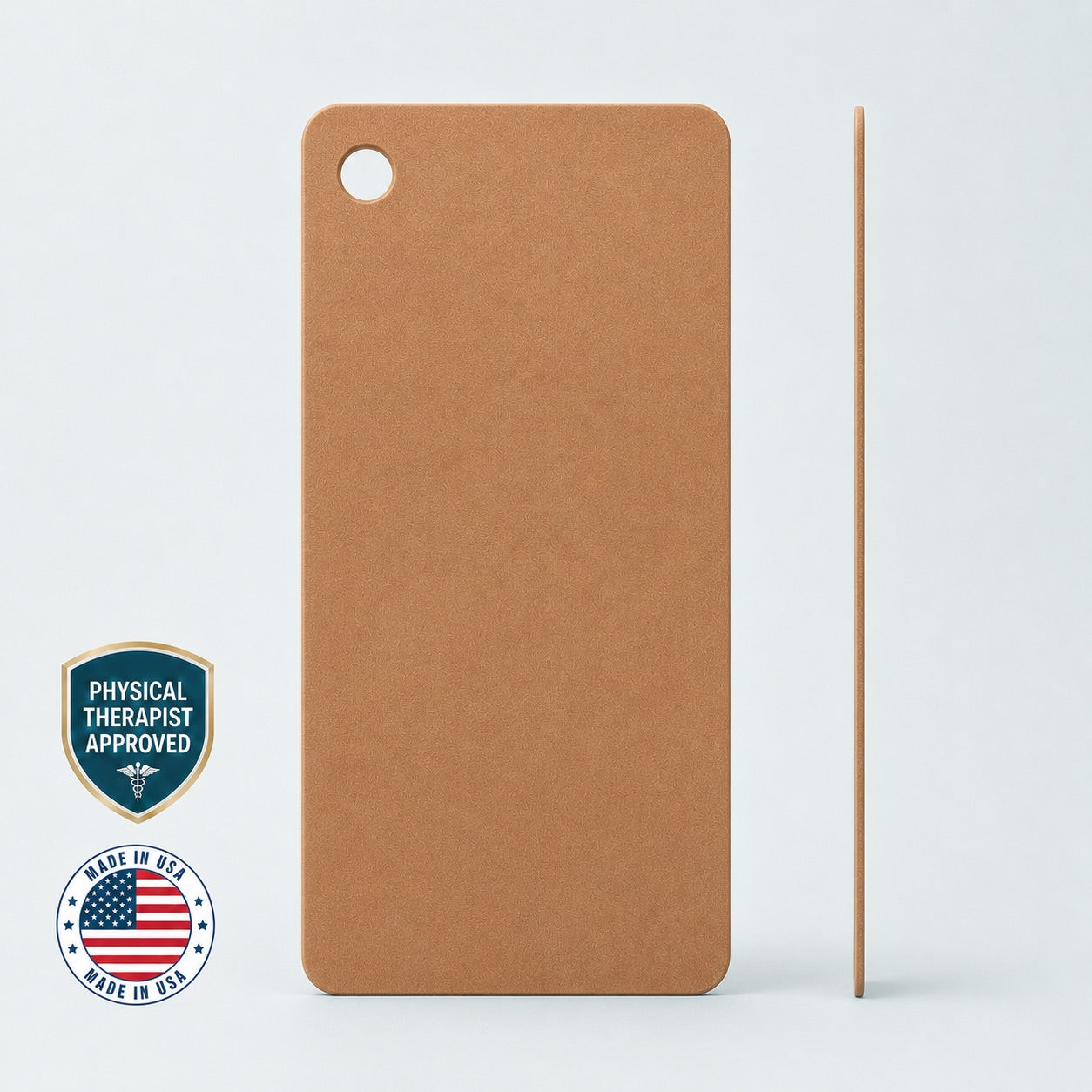
The Timing Window, in Real Numbers
This is the part every page mentions and almost none of them quantify, so here it is plainly.
What waiting costs
In a review of 144 manipulations out of 2,128 knee replacements at a single institution, patients manipulated within twelve weeks of surgery gained a mean of 36.5 degrees of flexion and finished with 119 degrees of motion. Those manipulated later gained 17 degrees and finished with 95. The authors concluded surgeons should keep a low threshold for manipulating within the first twelve weeks, and that manipulations performed beyond 26 weeks produced unsatisfactory clinical outcomes in that series.
Source: Issa et al., J Bone Joint Surg Am 2014, reviewed in Mamarelis et al., Ann Transl Med 2015
Thirty-six degrees versus seventeen. One hundred and nineteen versus ninety-five.
Look at what that second pair means in daily life rather than on a protractor. Level walking takes roughly 60 to 75 degrees of bend. Stairs take roughly 80 to 90 at every level, including step over step — that progression is driven by quad strength and pain rather than by range. Sitting in a chair takes about 90, standing back up without pushing off about 95, and getting into a car 100 to 110. A knee at 119 degrees clears all of that with room to spare. A knee at 95 still manages stairs and a normal chair, but it sits right at the line where daily function starts to be measurably affected — and it has nothing left over for a car seat, a bath, or the days the knee is stiffer than usual.
That is the actual stake. Not a statistic — whether stairs are a thing you think about.
Is It Too Late?
Probably not, and the honest answer here is better than the internet's.
Plenty of pages read as though twelve weeks is a door that slams. The evidence is kinder than that. In a 2024 review of 152 patients who had a late manipulation — from twelve weeks out to more than a year after surgery — all three timing subgroups significantly increased their overall range of motion, by averages of 20.9, 19.2 and 22.0 degrees (Weintraub et al., J Knee Surg 2024). Notably, motion improved slightly more as time from surgery increased, though that difference wasn't statistically significant.
Two honest caveats alongside that. Twenty degrees is a real gain, but it is not the 36.5 that early manipulation produced. And late manipulation carries a small risk of fracture during the procedure — the overall intraoperative fracture rate across that series was 1.3%.
So: earlier is decisively better, and later is still worth a conversation. If you are six months out and stuck, the correct move is to ask your surgeon now rather than conclude from a blog that you've missed your chance.
What Actually Happens — and How Sore You'll Be
I'm going to be careful here, because this is the part where a lot of pages invent detail.
The core of it is simple: you're sedated, and the surgeon bends the knee for you to free up the scar tissue restricting it. It is a short procedure, and it is not a revision of your replacement — nothing is taken out or swapped.
What I can't tell you from the evidence is exactly how long it takes at your hospital, what anesthesia you'll have, whether you'll go home the same day, or precisely how much it will hurt afterward. Those vary by surgeon and by centre, and the published studies I'd want to quote simply don't report them. Ask your surgical team directly — and specifically ask what pain control you'll have for the first few days, because that's the part patients tell me caught them off guard.
What I can tell you honestly: the days afterward are sore and swollen, patients describe it very differently from one another, and the soreness is the price of the range, not a sign something went wrong. Your team should tell you what's expected for you.
On safety, the numbers are reassuring. In a series of 31 patients manipulated as first-line treatment, no complications occurred (Archunan et al., Cureus 2021). Across the late-manipulation review, the overall intraoperative fracture risk was 1.3% (Weintraub et al., J Knee Surg 2024). Small, not zero — which is exactly the kind of number to weigh with your surgeon rather than alone at midnight.
The Two Weeks After Decide What You Keep
This is the most important section on the page, and it's the one the ranking pages skip.
A manipulation gives you range. It does not give you the ability to hold onto it. The motion gained in the operating room has to be sustained through therapy afterwards — that principle is stated explicitly for arthroscopic release (Leggett et al., JBJS Essent Surg Tech 2023) and it is exactly how your team will approach an MUA too.
Think of it as a reset, not a repair. The scar tissue that was limiting you has been disrupted, and your knee now has a window in which it will heal again — into whatever range you spend those weeks using. Use a small range and it will heal to a small range.
So the practical answer to "what do I do afterward" is: the same work you were already doing, started promptly, done gently, and done often. Expect your surgeon or PT to have you moving the knee within a day. Follow their schedule, not this page's.
Two things I'd emphasise from the PT side:
Frequency over force, more than ever. The knee is inflamed from the procedure, and inflammation is the raw material scarring is made from. Short, calm, frequent sessions beat two heroic ones.
Don't let the soreness cost you the first week. The instinct after a sore procedure is to rest until it settles. That week is the most valuable one you have, which is why pain control matters and why it's worth asking about in advance.
What the Outcomes Data Actually Shows
Here's the honest picture, including the parts that aren't flattering.
The motion is real
In a series where manipulation was used as first-line treatment for stiffness, mean flexion improved from 51.8 degrees to 93.2 degrees and the arc of motion improved in 100% of patients (Archunan et al., Cureus 2021). In a large registry, manipulation improved range of motion by an average of 34 degrees (Owen et al., J Arthroplasty 2021).
But you may not fully catch up
In that same registry, patients who needed a manipulation still had less motion at final follow-up than patients who never became stiff — 102 degrees versus 116 (Owen et al., J Arthroplasty 2021). That's a meaningful gap, and it's a fair part of why getting ahead of stiffness is worth so much effort.
Compared with the alternatives, it does well
A systematic review of 40 studies comparing manipulation, arthroscopic lysis of adhesions and revision knee replacement for stiffness found that 17% of manipulation patients needed further care, compared with 25% after arthroscopic release and as many as 43% after revision. Knee Society clinical and functional scores were highest in the manipulation and arthroscopic release groups, and mean or median post-procedure arc of motion exceeded 90 degrees in 7 of 10 manipulation studies (Haffar et al., Int Orthop 2022).
Of the three ways to attack a stiff replacement, manipulation is the least invasive and has the best track record. Revision surgery for stiffness has the poorest outcomes of the three.
The statistic that frightens people, explained
You may run into this one: patients who needed a manipulation within six months of knee replacement had a significantly higher risk of early revision surgery (Werner et al., J Arthroplasty 2015).
Read carefully, because the obvious interpretation is the wrong one. That is an association found in a claims database, not evidence that the manipulation damaged anything. Patients whose knees stiffen badly enough to need manipulating are a higher-risk group to begin with — that's why they got stiff. The statistic is telling you that a knee that scars aggressively is a knee with a harder road, which you already knew. It is not telling you that agreeing to an MUA puts you on that road.
If the First One Doesn't Hold
Sometimes it doesn't, and almost nobody writes about that, which leaves the people it happens to feeling like a special case. They aren't.
In a review of 226 knees manipulated at two surgeons' practices, 16 went on to a second manipulation. In those patients, at a mean follow-up of 539 days, mean flexion improved from 87.5 degrees to 112.7 degrees and mean extension from 10.5 degrees to 2.5. Two of the 16 (12.5%) had a complication, and three of 16 (18.8%) went on to revision surgery. The authors concluded a second manipulation can achieve functional range of motion that is sustained (Ferrel et al., Surg Technol Int 2015).
So a second manipulation is a real option with real results, and a higher risk profile than the first. Beyond that, arthroscopic lysis of adhesions is considered for patients whose stiffness has already failed both a manipulation and non-operative treatment, where gains have plateaued (Leggett et al., JBJS Essent Surg Tech 2023). Arthrofibrosis can be treated effectively in the early stages with manipulation, with or without lysis of adhesions, while patients who don't respond may need revision surgery — which generally has poorer outcomes for this indication (Buchalter et al., Bull Hosp Jt Dis 2024).
The through-line in all of it: each step down that ladder works less well than the one before. Which is the argument for taking the first step early.
Questions to Ask Your Surgeon
Take these with you. They're the ones I'd want answered.
- What's my measured flexion today, and what number would make you act?
- How many weeks post-op am I, and how much of the twelve-week window is left?
- If we wait another month, what would you expect to gain or lose?
- What pain control will I have for the first few days afterward?
- How soon will I start moving the knee, and who's supervising that?
- How many PT sessions will I have in the two weeks after, and can they be booked now?
- What happens if the range doesn't hold?
That sixth one matters more than it looks. The window after a manipulation is short and it's the whole ballgame — finding out afterwards that your next PT appointment is in three weeks is a bad surprise.
And one more thing, because the research supports it: patients routinely report their pain and stiffness concerns being brushed off. If something feels wrong to you, push. You're the only person measuring this knee every day.

Recovering from a knee replacement right now?
Get my 12-week recovery checklist as a free printable PDF. One email. Stick it on the fridge and check off your milestones.
✓ Check your inbox. The checklist is on its way.
Frequently Asked Questions
How painful is it after a knee manipulation?
The procedure itself is done under anesthesia, so you won't feel it happening. The days afterward are sore and swollen, and patients describe the intensity very differently from one another. I won't give you a number, because the published studies don't report one and anyone quoting you a figure is guessing. Ask your surgical team what to expect and, specifically, what pain control you'll have for the first few days — the soreness is worth planning for, because resting through the first week is the main way people lose the range the procedure just gained them.
When is it too late for a knee manipulation after knee replacement?
Rarely absolute, but earlier is substantially better. Within twelve weeks of surgery, manipulation produced a mean flexion gain of 36.5 degrees and 119 degrees of final motion, versus 17 degrees and 95 degrees when done later. That said, a 2024 review of 152 late manipulations performed from twelve weeks out to beyond a year found all three timing groups still gained significant motion, averaging around 20 degrees. If you are months out and stuck, that is a conversation to have with your surgeon now rather than a door you've missed.
What percentage of people need an MUA after knee replacement?
In a national database of 141,016 knee replacements, 4.3% of patients had a manipulation under anesthesia within six months. Individual hospital series range from about 2.29% to 8.6%, and that spread is mostly explained by different thresholds for calling a knee stiff rather than by different patients — some centres manipulate at under 90 degrees at six weeks, others wait for much more severe restriction.
Is manipulation under anesthesia worth it?
For most patients with genuine stiffness, the evidence is favourable. Manipulation improved range of motion by an average of 34 degrees in one large registry, and in a systematic review of 40 studies it had the lowest rate of needing further care — 17%, versus 25% after arthroscopic release and up to 43% after revision surgery — with the highest Knee Society scores. The honest counterweights are that manipulated knees still averaged less final motion than knees that never stiffened (102 versus 116 degrees), and that the procedure carries a small fracture risk, around 1.3% in one late-manipulation series. It is a decision to make with your surgeon, but it is the least invasive of the options for a stiff replacement.
How can I avoid a manipulation after knee replacement?
The lever you control is consistent daily flexion work inside the first six weeks: heel slides at 3 sets of 10, two to four times a day, with 3 to 5 second holds, on a surface smooth enough that your heel glides instead of catching. Add overpressure once your own muscles stall around 90 degrees. Keep the knee calm between sessions with ice and elevation — propping the ankle, never a pillow under the operated knee — because the scarring mechanism is inflammatory. And escalate on a schedule rather than a feeling — if the number has stayed flat across two to three weeks, call. Several of the strongest risk factors, including your age, your sex and the motion you had before surgery, are not things you chose.
What happens to scar tissue after a knee manipulation?
The manipulation disrupts the scar tissue that was restricting the joint, which is what gives you the immediate range. It does not remove it, and your knee will heal again over the following weeks — into whatever range you spend those weeks using. That is the whole reason the two weeks after the procedure matter so much: the motion gained in the operating room has to be sustained through therapy, or the knee closes back down around the smaller range.
Do some people need a second knee manipulation?
Yes, and it isn't a rarity worth panicking about. In a review of 226 manipulated knees, 16 had a second manipulation, and in those patients mean flexion improved from 87.5 to 112.7 degrees at a mean follow-up of 539 days. Two of the 16 had a complication and three went on to revision surgery. The authors concluded a second manipulation can achieve functional range of motion that is sustained.
Does needing an MUA mean my knee replacement failed?
No. A manipulation is not a revision — nothing about your implant is removed or exchanged. It is a procedure to address scar tissue restricting the joint, and it is the least invasive of the treatments for a stiff replacement. You may see a statistic linking manipulation to a higher rate of early revision surgery; that is an association found in a claims database, reflecting that knees which scar aggressively are a higher-risk group to start with, not evidence that the manipulation itself caused harm.
The Window Is the Whole Thing
Whether you end up having a manipulation or avoid one, the same work decides it: measured, consistent daily flexion, started early and kept up. Our full heel slides guide covers the technique, and the stiff knee guide covers what to check first.
The EquipCore Heel Slide Board gives your heel a surface that glides instead of grabbing — so the last few degrees of every rep actually happen, before the window closes and after it reopens.
Shop the Heel Slide Board →PT-Designed | Free Shipping | 30-Day Returns
Disclaimer: This guide is for educational purposes and does not replace the advice of your surgeon or physical therapist. Always consult with your medical team before beginning new exercises.
Tell me what you're recovering from and where you're at — I'll point you to the right tool, or tell you honestly if you don't need one yet. Every message comes straight to me, and I read every one personally.