

Knee Replacement Recovery, Week by Week: How Long It Takes and How Far Most Knees Bend
 Dr. Joe Armeli, DPT
"How many degrees should my knee bend by now?" It's the question I get on almost every follow-up call. Here is how long a knee replacement recovery actually takes, week by week, alongside the typical flexion benchmarks — what each number unlocks in daily life, why timelines vary, and when a plateau means it's time to call your PT.
How far your knee bends is one of the best day-to-day markers of how smoothly you'll get back to normal life, and the daily work you do at home is most of the game. Running behind early doesn't decide where you finish — patients discharged under 90 degrees still landed around 120 by a year out. The daily work you do at home isn't optional in this recovery — it's most of the game.
Key Takeaways
- How long the whole recovery takes: the full milestone-by-milestone timeline — walker, driving, desk work, sport — is in the next section.
- Weeks 1-2 target: roughly 90° of knee flexion is the typical early goal your surgeon and PT will ask for.
- Weeks 3-6 target: most patients work from about 90° toward 110°, enough to sit comfortably, manage stairs with a rail, and start easing into a car seat.
- Weeks 7-12 target: 110-120°+ is the typical range patients are approaching or hitting. By this point the everyday thresholds — chair, stairs, car — are already behind you, and the work shifts toward comfort, strength and the last few degrees.
- These are ranges, not promises. Every knee replacement recovery timeline is individual, and your surgeon's protocol always overrides anything you read online.
- The exercise that moves the needle most is heel slides, paired with terminal extension work so you don't trade bend for straightness.
- A plateau that stays flat across two to three weeks of consistent daily work is the signal to call your PT or surgeon, not to wait it out.
- Browse our full knee replacement recovery equipment collection if you're building your home rehab setup from scratch.
Want the rest of your recovery milestones, not just your bend?
Get my free 12-week recovery checklist as a printable PDF. Written by a PT, one email, no spam.
✓ Check your inbox. The checklist is on its way.
How Long Does Knee Replacement Recovery Take?
The short answer: there isn't one number, because the different parts of recovery come back at different times. Everyday activities start feeling comfortable somewhere around weeks 4 to 6. Most of your strength and ease is back between 6 and 12 weeks. And small gains can still show up out to a full year.
Here's the order I usually see things arrive in. Same caveat as the bend targets further down: these are typical ranges, not deadlines, and your surgeon's protocol always wins. If you're a clinician, the full total knee replacement rehab protocol maps these same phases with interventions and function-based criteria to progress.
| When | What Typically Comes Back | Worth Knowing |
|---|---|---|
| Days 0-14 | Walker, sitting in a chair, bathroom independence — and your first exercises: working the knee fully straight, heel slides, quad sets, ankle pumps | Extension work starts day one and matters most of the four — scar tissue lays down early and gets harder to move later. Most people are up with a walker the day of surgery or the next morning; how long you stay in the hospital is your surgeon's call. |
| Weeks 1-2 | Rocking the pedals on a stationary bike; the push toward fully straight (0°) | Most protocols look for full extension by about week 2 — typically within about 5° of straight at two weeks, and all the way to 0° by week 4. This is the one target worth treating as a deadline. If you are past it and still short, keep chasing it — extension can keep improving out to about six months, so a knee that is short at week 2 is not a lost cause. That said, if you are still more than about 10° short at week 4 and not gaining, that one is worth a call to your surgeon. |
| Weeks 2-4 | About 90° of bend — enough to sit in a normal chair | Protocols look for 90° by about week 2; most people actually get there somewhere in weeks 2-4. Both are normal. |
| Weeks 4-6 | Everyday activities start feeling comfortable | Full smooth revolutions on a bike come once you are around 100-110°, which for a lot of people lands about here. |
| Weeks 4-8 | Desk work | Depends on your commute and whether you can elevate the leg during the day — prop it under the ankle so the knee stays straight, never on a pillow under the knee. |
| Your surgeon's call | Driving | A left knee is usually around week 4; a right knee usually weeks 6-8. Your surgeon clears this either way — it depends on your reaction time and being off narcotic pain medication, not on the calendar. |
| Weeks 6-12 | Strength, ease, and most normal activity | This is where the bulk of feeling like yourself again happens. |
| Months 3-4 | Low-impact sport — swimming, golf — with your surgeon's clearance | Also the point to start working on kneeling: uncomfortable, not dangerous. Pad it, build up gradually, and confirm your implant with your surgeon. |
| Months 3-6 | Strength and endurance become the main work — without dropping the range work | Flexion progress slows around month 3, but months 3-6 is the last stretch where extension gains come easily, and flexion can still creep up. |
| Months 6-12 | Strength and confidence; flexion settles around 117-122° | Progress slows after month 3, but small gains can still happen out to a year. |
Here's what I tell patients to take from this: most of the fast progress happens in the first three months. After that it slows down, but it doesn't stop. Gains of 5-10° a week are common in the first six weeks; after that, 1-2° a week is real progress, not a stall.
For what the therapy itself looks like at each of these stages — the sessions, the exercises, and what to do if you stall — see our full guide to physical therapy after knee replacement.
Why Knee Bend After Knee Replacement Matters More Than How the Scar Looks
Your surgeon gave you a new joint. The weeks and months of rehab that follow determine how well you actually use it.
Knee bend after knee replacement isn't a cosmetic milestone. It's functional currency. Every degree you're short on flexion shows up later as a stair you can't take normally, a car seat you have to back into sideways, or a bike pedal you can't complete a full rotation on.
Extension — getting the knee all the way straight — is the range that's hardest to win back if you let it slide in the first couple of weeks. Scar tissue doesn't care about your schedule. It forms whether you're doing your knee replacement exercises or not, and it forms in whatever position your knee sits in most.
Knee Bend After Knee Replacement — Degrees of Flexion Week by Week
Here's the timeline I give every TKR rehab patient, in typical ranges. Nobody's knee reads a calendar, so treat these as targets to fight for, not deadlines to panic about.
| Timeframe | Typical Flexion Range | What It Usually Enables |
|---|---|---|
| Weeks 1-2 | Working toward ~90° | Getting out of bed, basic transfers, first assisted walks |
| Weeks 3-6 | ~90° → 110° | Sitting in a standard chair, stairs with a rail, easing into a car seat |
| Weeks 7-12 | 110° → 120°+ | Full daily comfort — the everyday thresholds are already behind you |
| Months 3-12 | 115-125°, settling around 117-122° by a year (130°+ is a best case, not the target) | Deeper functional tasks like sitting in a low chair or bathtub |
Again: typical, not guaranteed. Your surgeon's specific protocol and your own tissue always take priority over a table on the internet.

The exercise doing most of the heavy lifting in that table is heel slides. If you haven't read it yet, our heel slides guide walks through exactly how to load this movement safely, whether you're in week 1 or week 6. If you're in that first week right now, here's what's normal 1 week after knee replacement. Early on, do them in bed or on the couch — the floor typically waits until around two months, once your PT clears you for floor transfers. If you're deciding where to do them, we compare wall vs floor heel slides too.
What These Degrees of Flexion Mean Week by Week: Stairs, Cars, and the Stationary Bike
Degrees on a goniometer don't mean much until you connect them to your actual day. So let's connect them.
Walking on level ground only takes about 60-75° of bend. Stairs are a different animal entirely, typically requiring 80-90° to clear a step without compensating through your hip.
Getting into the passenger seat of a sedan (swinging your leg in, not just standing and pivoting) usually needs 100-110° or more, which is why patients who plateau around 90° often tell me the car is the thing that finally motivates them to fight for more range. A stationary bike is one of the best tests of functional flexion. Rocking the pedals back and forth starts in the first week or two; a full, smooth revolution usually becomes possible somewhere around 100-110°.
Deeper flexion, around 135°, is what you need for things like sitting comfortably in a bathtub or squatting low to the floor. Most patients don't need to chase that number aggressively unless a specific hobby demands it, but it's good to know the ceiling exists.
What Does a 90°, 100°, 110° and 120° Knee Bend Look Like?
Degrees are hard to picture, so here's how I show patients: sit in a chair with your thigh on the seat. At 90°, your shin points straight down and your foot sits right under your knee. Every 10° past that tucks your foot a little further back under the chair. (0° is your leg fully straight.)


Want to know where your own knee is? You don't have to guess from a picture: measure your knee bend with your phone. And if you like data, researchers have built a reference chart for knee flexion after knee replacement from 1,173 measurements in 327 patients over the first 120 days after surgery (Kittelson et al., 2020). It works like a child's growth chart: it shows where a knee sits compared with other people at the same point in recovery.

Bend coming slower than you hoped?
Heel slides are the #1 prescribed exercise for getting your bend back.
Most protocols call for 3 sets of 10, two to four times a day, with 3- to 5-second holds. That's a lot of reps to drag your heel across a bedsheet. The Heel Slide Board gives your heel a smooth, low-friction surface, so each slide glides instead of catching, and the reps are easier to keep up.
Free shipping · 30-day money-back guarantee
Still under 90° at 6 to 8 weeks, or flat for two to three weeks of consistent daily work? That's worth a call to your surgeon. A board won't fix that.
Why Individual Timelines Vary After Total Knee Replacement Recovery
I can treat two patients on the same surgical protocol, same surgeon, same implant, and watch one hit 110° by week 4 while the other is still fighting for 95°. Same procedure, different knee, different scar tissue, different pain tolerance for pushing the stretch.
Age, pre-surgery flexibility, how swollen the joint gets, and honestly, how consistently someone shows up for their knee replacement exercises every single day all shift the timeline. Post-surgery rehab isn't a passive process your body does to you. It's an active one you do to your body.
Where Most Knees Actually Land
A year out, most knees settle around 120°. In a study of 182 knee replacements, average flexion at twelve months was 120–122° — and it made no difference whether the patient had reached 90° by the time they left the hospital.
Source: Richter et al., Orthopädie
Deeper ranges do happen — one study of high-flexion patients found 68% got past 130° — but that is a best case, not the bar you are being measured against. If you land in the 120s, you have landed where most people land. Keep working the range you have, and loop in your PT early if something feels stuck.
The TKR Rehab Tools I Send Every Patient Home With
I put this toolkit together because most TKR patients get sent home with a printed exercise sheet and zero equipment. Bedsheets and blankets fight you the whole way through a heel slide. Here's what actually works.
Heel Slide Board
The Heel Slide Board gives your heel a smooth, low-friction surface, so heel slides (the #1 exercise your surgeon and PT prescribe) stop turning into a wrestling match with your comforter.
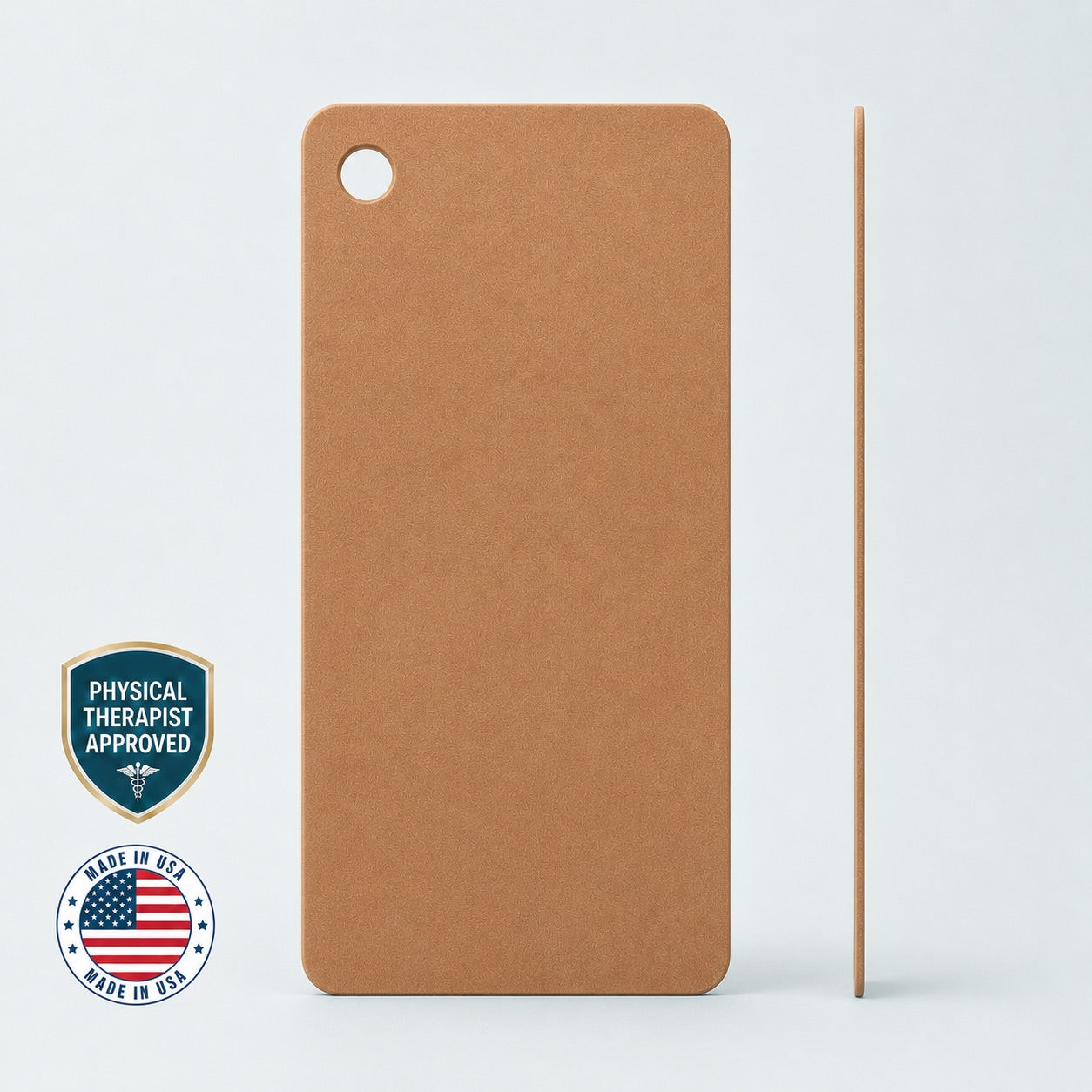
Made in the USA, and it's the tool I point to when a heel slide keeps stalling on the sheets instead of moving the knee.
KneEXT Foam Roller
Flexion gets all the attention, but terminal extension (getting the leg fully straight) is the goal patients forget until it bites them later. The fastest way to lose it is quiet: sleeping or resting with a pillow propped under your knee. It feels great, and it slowly costs you your straight leg — prop the ankle instead, and let the knee hang flat.
To win extension back actively, the KneEXT roller is the right height for short arc quads, one of the first exercises for waking the quadriceps back up after surgery.

Soft floor pads collapse under your leg's weight, which is why generic foam rollers fail at extension stretches. The heel cut-out lets your leg hang unsupported for a true prolonged stretch.
Non-Elastic Stretch Strap
Once you're past the first stiff week, a strap lets you assist your own heel slides and add hamstring and calf stretches without needing a second person in the room. Our full guide to heel slides with a strap walks through the active-assisted technique and exactly when to drop the strap.

The 10 loops let you shorten your reach as your flexion improves, so the same strap works from week 1 through week 8.
Total Knee Rehab Kit
For patients who want everything (extension, flexion, and stretching) in one order, this is the kit. It's the KneEXT, the Heel Slide Board, and the Stretch Strap together for $94.99.
Everything your PT prescribes for a full 12-week recovery, in one box, clinic-grade and built for the living room.

Want the whole timeline, not just the flexion numbers?
Get my 12-week recovery checklist as a free printable PDF. One email. Stick it on the fridge and check off your milestones.
✓ Check your inbox. The checklist is on its way.
When to Talk to Your PT or Surgeon About a Plateau
Not every stall is a red flag. Swelling has good days and bad days, and a rough night's sleep can cost you five degrees the next morning. Before you assume the worst, make sure your daily work is actually targeting the bend — I've laid out the six knee flexion exercises I use to break a plateau in one place.
If your bend is still under about 90° at six to eight weeks — even if the number is still creeping up a degree here and there — that's the point to call your surgeon, not to wait it out. They may raise a manipulation under anesthesia (MUA): a brief procedure, done while you're fully under, where the surgeon frees up the scar tissue holding the knee back. It's a normal next step, not a failure. It also works best inside the first 12 weeks, which is exactly why the call is worth making early — the same procedure done later gains noticeably less range. And if your bend goes backward for a day or two, monitor it rather than panic — a heavy day often costs you a few degrees the next morning as soreness and swelling catch up. What matters is the trend across weeks, not any single morning.
Tell your PT or surgeon exactly what you're doing at home (how many reps, what tools, what pain level) so they're not guessing either. Progress you can measure is progress you'll keep showing up for. For the bigger picture of what a good program actually does at each stage, our guide to physical therapy after knee replacement walks through it phase by phase.
Measuring Your Knee Bend at Home
You don't need a clinic visit to know your number. A simple goniometer app or even a protractor against your shin and thigh will get you close enough to track trends week over week.
Write the number down — daily in the first 6 weeks (daily numbers are how you spot the trend), weekly from six to twelve weeks, then monthly after that. A single measurement means nothing; the trend does. A trend line over three weeks tells you everything about whether your knee replacement exercises are actually working.

Stop Guessing. Measure Your Knee Bend With Your Phone.
My free knee flexion tracker measures your bend from a side-view photo of your leg. It finds your hip, knee, and ankle, shows your angle in seconds, and charts every measurement so you can watch your number climb week to week.
Measure My Knee Bend Free →Frequently Asked Questions
What is a normal knee bend after knee replacement at 2 weeks?
Most protocols look for about 90° by the two-week mark, and most people actually get there somewhere in weeks 2 to 4. Consistency with heel slides during these early weeks matters more than hitting an exact number.
How many degrees of knee flexion do I need to walk normally?
Walking on level surfaces generally requires only 60-75° of knee bend. Stairs demand more, typically 80-90°, which is why many patients feel confident walking before they feel confident on steps.
Is 90 degrees of knee bend good in the first two weeks after knee replacement?
Yes. Roughly 90° by around the two-week mark is a commonly cited target and a solid sign your total knee replacement recovery is on track. Hitting it sooner is a bonus, and your surgeon's specific goals for you always take priority.
What happens if my knee flexion plateaus at 100 degrees?
A short plateau isn't unusual, but if your flexion hasn't budged across two to three weeks despite daily knee replacement exercises, it's time to talk to your PT or surgeon. Interventions exist for stalled flexion, and they work best when caught early rather than months later.
How long does it take to get 120 degrees of knee flexion after knee replacement?
Many patients approach 110° around week 6 and reach 120° somewhere in the two-to-three-month range, though individual timelines vary based on age, swelling, and how consistently daily stretching is done. Some patients need longer, and that's not a failure, it's just their knee's timeline.
What does a 120 degree knee bend look like?
Sitting in a chair, a 120° bend puts your heel well back under the seat, about 30° past the point where your shin points straight down (90°). Most protocols look for 120° or more by about 3 months, and most knees settle around 117-122° by a year.
Can I do heel slides and extension exercises on the same day?
Absolutely, and most PTs recommend it. Alternating heel slides for flexion with short arc quads or prolonged stretching on a roller like KneEXT for extension keeps both directions of motion moving together instead of trading one for the other.
Is it normal for knee bend to vary a lot from person to person after knee replacement?
Yes, it's completely normal. Studies show a wide spread, with some patients reaching high flexion past 130° and others settling in a lower functional range, so comparing your exact numbers to someone else's recovery isn't a useful measuring stick.
Fight for Every Degree While It's Easy to Win
Roughly 90° by two weeks, 110° by six weeks, and 120°+ by three months — always a range to aim for, never a guarantee. Keep your recovery moving with heel slides and terminal extension work daily, and loop your surgeon in if a plateau outlasts two to three weeks.

The Total Knee Rehab Kit covers flexion, extension, and stretching — everything your PT prescribes for a full 12-week recovery, in one box.
Shop the Total Knee Rehab Kit →PT-Designed | Free Shipping | 30-Day Returns
Want the whole timeline mapped out day by day? Read the 12-week recovery checklist →
Disclaimer: This guide is for educational purposes and does not replace the advice of your surgeon or physical therapist. Always consult with your medical team before beginning new exercises.
Tell me what you're recovering from and where you're at — I'll tell you honestly whether you're on track or need to push harder. Every message comes straight to me, and I read every one personally.