

1 Week After Knee Replacement: The Hardest Days, What's Normal, and When to Call
 Dr. Joe Armeli, DPT
For many people, the first week home is one of the hardest stretches of the whole recovery. Here's where most people are at one week, why the back half of that week feels the worst, what's normal, and the few things that are worth a same-day call to your surgeon.
Key Takeaways
- The hard stretch starts when the nerve block or anesthesia wears off and usually peaks around days 5 to 7. It's a very common low point, not a sign something is wrong.
- At one week, most people are walking short distances with a walker, bending somewhere around 70-85°, and within about 10° of straight and improving.
- Pain with movement is expected. Sharp, electric or stabbing pain means stop.
- Bruising down to the ankle and a numb patch beside the incision are both common.
- Get the knee straight first. Extension work leads the day, with heel slides, quad sets and ankle pumps alongside.
- One of the most common week-1 mistakes is a pillow under the knee. Support the leg under the ankle instead, so the knee can straighten.
- Your surgeon's discharge instructions come first. A fever (per your surgeon's instructions) or a hot, swollen knee, calf pain or swelling, or a worsening incision are worth a call to your surgeon the same day.
Want the whole 12 weeks mapped out, not just week one?
Get my free 12-week recovery checklist as a printable PDF. Written by a PT, one email, no spam.
✓ You're in — download your checklist here →
Where You Should Be 1 Week After Knee Replacement
Here's what I typically see at the one-week mark. Treat these as ranges, not deadlines. Your surgeon's protocol always wins.
| At 1 Week | What's Typical | Worth Knowing |
|---|---|---|
| Walking | Short walks around the house with a walker | About five minutes every waking hour. When you move to a cane is decided with your physical therapist, not by the calendar. |
| Bending | Somewhere around 70-85° | In one study that measured patients every week, the median bend in week one was about 80° (Kornuijt et al., 2019). |
| Straightening | Within about 10° of straight, and improving | Most protocols push for full extension by about week 2 and expect it by week 4. It's the one goal worth pushing hard on. |
| Exercises | Extension work, heel slides, quad sets and ankle pumps, several times a day | All of these start on day one. Straight leg raises usually join in weeks 1-2. |
If your bend is a little behind those numbers at one week but still moving, it isn't a verdict. In a study of 182 patients, people who left the hospital short of 90° still averaged about 120° a year later, the same as everyone else (Richter et al., 2023). Early straightening is the one to fight for. If your bend is well under that range and not changing, or the knee isn't getting any straighter, tell your physical therapist. For the full picture past week one, see the knee replacement recovery timeline, week by week.
Your First Week, Stage by Stage
Every knee moves at its own pace, but the first week follows a similar arc for most people.
-
In the hospital
Surgery day and the hospital
They'll have you up almost immediately. The first goals are simple: standing and taking steps with a walker, sitting in a chair, and starting your first exercises: getting the knee straight, ankle pumps and quad sets. Some people go home the same day. That depends on how well you're moving and on having someone at home to help.
While the nerve block or anesthesia is still working, many people feel better than they expected. Enjoy it, but don't read it as the new normal. It's the calm before the harder stretch.
-
Home
The first days at home
This is when the routine starts for real: ankle pumps and a short walk every waking hour, your exercise sessions several times a day, and ice and elevation after each one. Getting to the bathroom, in and out of a chair and around the house with the walker are the goals of the first two weeks.
Most people move straight on to outpatient physical therapy at a clinic. Home health visits, where a therapist comes to you, are used when they're medically necessary. They're not a step everyone passes through. There's no set number of visits; how much therapy you get is based on medical necessity. Our guide to physical therapy after knee replacement explains what those visits look like.
-
Days 5-7
Days 5 to 7: the low point
For most people the hard stretch peaks here. Pain, poor sleep and fatigue can all stack up at the same time. It's a very common low point, and it passes. The next section explains why it happens.
-
End of week 1
The end of week 1
Most people are walking short distances with the walker, bending somewhere around 70-85°, and within about 10° of straight and improving. If that's you, you're right on track.
Why the Back Half of Week 1 Feels the Hardest
A lot of people feel better than they expected in the hospital. That's because the nerve block or anesthesia from surgery is still doing its job.
The hard stretch starts when it wears off, and for most people it builds to a peak around days 5 to 7. By then you're home, you're doing more, and you probably haven't slept well in days. It's a very common low point, and it's not a sign that something has gone wrong.
What gets you through it is the routine below, done a little at a time, every day:
- Little and often. Short sessions spread through the day beat one big push that leaves you sore and swollen tomorrow.
- Ice and elevate after every session, with the support under your ankle.
- Keep moving every hour. Lying still all day makes the stiffness worse, not better.
- For pain medication, follow your surgeon's plan.
Knowing the low point is coming, and that it's normal, makes it a lot easier to get through.
What's Normal in the First Week
Pain when you move
After a knee replacement, nearly every movement hurts in the first two weeks, and that's expected. Discomfort is fine to work through. Sharp, electric or stabbing pain is the signal to stop.
Swelling
How much swelling you get, and how long it sticks around, varies a lot from person to person. Two things help. Elevate the leg with support under the ankle, never a pillow under the operated knee. And ice: in weeks 1-2, about 20 minutes every couple of hours, plus 15-20 minutes after each exercise session.
Bruising
Bruising is normal and can look dramatic. It often spreads down the shin to the ankle and foot over the first week or two as gravity pulls it down, then fades.
A numb patch beside the incision
A numb area on the outer side of the incision is common, because small skin nerves are cut during surgery. It often shrinks over the following months, and some people keep a small numb spot.
A stiff morning, or a day that goes backward
If you did a lot yesterday, you may wake up sorer, more swollen and a few degrees tighter. That's the expected cost of a big day, not a reason to call. Watch the trend across weeks, not one morning.
Rough sleep
Sleep is often broken in the first week, and it's one of the biggest reasons the back half of the week feels so hard. A few things help:
- On your back, support the leg under the ankle so the knee can straighten. Never put a pillow under the knee, even though it feels good.
- On your side, once it's comfortable, put a pillow between your knees. There's no set week for this; comfort decides.
- If you're using an ice machine, know that it isn't better for your knee than a regular cold pack. What it does offer is convenience: it stays cold without refilling, which genuinely helps overnight and in the first week.
A bad night doesn't undo your progress. Get back to the routine in the morning.
Feeling wiped out or down
Feeling exhausted and a bit down in the first couple of weeks is common. Poor sleep, pain and being stuck on the couch all add up, and so does going from independent to needing help with the basics. It helps to know it's part of the process, not a sign you're doing something wrong. If it doesn't lift, or you're struggling, tell your primary care doctor.
Your Week-1 Routine
This is the routine I give patients for the first two weeks. It's simple on purpose.
Ankle pumps + a short walk
- Ankle pumps: point and flex your feet.
- A walk of about five minutes with your walker.
Your exercise sessions
- Extension first, 2 to 3 times a day.
- Heel slides, 2 to 4 times a day.
- Quad sets and ankle pumps, as your PT has shown you.
Ice and elevate
Ice for 15-20 minutes and elevate the leg with the support under your ankle, never a pillow under the knee.
Measure your bend
Daily numbers in the first six weeks are how you spot the trend. Don't sweat any single reading.
That hourly movement is the main thing protecting you from blood clots. If your surgeon told you to wear compression stockings, wear them. They're low-risk and standard, but they're not the main thing protecting you. The hourly movement is.
Step-by-step instructions for each exercise are just below. Heel slides are the #1 prescribed exercise for regaining knee flexion, and they're where a lot of people get stuck in week one: the heel catches on the sheets and every rep turns into a fight. Our heel slides guide covers technique, and heel slides in bed covers exactly how to set them up in the first few weeks.
When the Sheets Fight Your Heel Slides
On a mattress, your heel sticks, catches and bunches the sheet, so the slide stutters instead of gliding. The EquipCore Heel Slide Board gives your heel a smooth, low-friction surface on the bed or couch, so each rep is one continuous slide.
Shop the Heel Slide Board — $39.99 →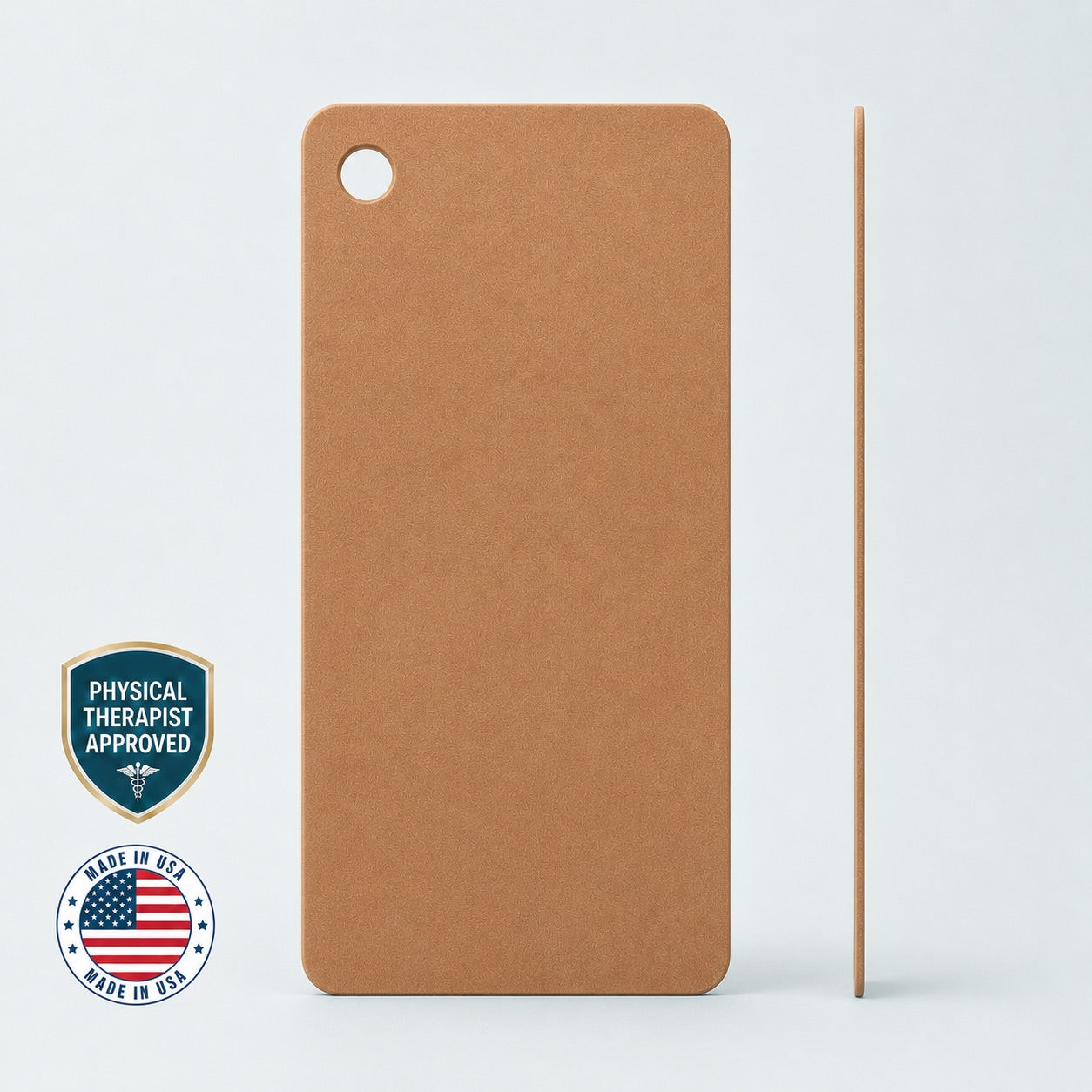

Measure Your Bend Once a Day
My free knee flexion tracker measures your bend from a side-view photo on your phone and charts every reading, so you can watch the trend over weeks instead of worrying about one number.
Measure My Knee Bend Free →For what physical therapy looks like from here, see our guide to physical therapy after knee replacement.
How to Do the Week-1 Exercises
These are the four exercises almost every week-1 program includes. Extension comes first; the rest go alongside it. Your PT may adjust them, and their instructions win.

1. Extension Hang
This one is uncomfortable, and that's the point: a slow, steady stretch. Sharp pain means stop. A roller with a heel cut-out, like the KneEXT foam roller, holds the heel in place so the knee can hang unsupported.
- 3-5 min, building to 10-15
- 2-3× a day
- Lie on your back or sit with the operated leg out straight.
- Prop your heel on a rolled towel or a roller so there is nothing under the knee.
- Relax your thigh and let gravity slowly straighten the knee.
- Start with 3-5 minutes and build toward 10-15 minutes as you can tolerate it.

2. Heel Slides
If your heel drags or catches on the sheets, the rep stutters and turns into a fight. That's the problem the Heel Slide Board was made to fix.
- 3 sets of 10
- 3-5 s hold
- 2-4× a day
- Lie on your back in bed or on the couch with the operated leg straight.
- Slowly slide your heel toward your buttock, bending the knee as far as you comfortably can.
- Hold 3-5 seconds at your deepest comfortable bend.
- Slide the heel back out until the leg is straight again.

3. Quad Sets
Quad sets get the thigh muscle working again after surgery.
- Reps and holds: per your PT
- Lie on your back with the operated leg straight.
- Tighten the muscle on the front of your thigh, pressing the back of your knee down toward the bed. Your kneecap should pull up slightly.
- Hold, then relax.

4. Ankle Pumps
Along with your hourly walk, this is the movement that keeps things circulating.
- Every waking hour
- Lying or sitting, point your toes away from you.
- Then pull them back toward your shin.
- Do a set every waking hour, the way your PT showed you.
Straight leg raises usually join in weeks 1-2, when your PT adds them. For more ways to work on your bend as the weeks go on, see our heel slides guide.
5 Mistakes to Avoid in the First Week
These are the ones I see most often. Every one of them is easy to fix.
1A pillow under the knee
It feels great, which is exactly the problem. A knee that rests bent all day and all night gets used to staying bent, and early on, a knee that won't straighten is harder to fix than a bend that's a little slow.
✓ Instead: put the support under your ankle.
2Working on the bend and skipping the straightening
The bend gets all the attention because it's the number everyone asks about. But getting the knee fully straight is the top priority early on, because scar tissue lays down in the first weeks and gets harder to break through later.
✓ Instead: do your extension work first, every session.
3Sitting still for hours
Long stretches on the couch make the knee stiffer and leave you less protected against blood clots.
✓ Instead: ankle pumps and a walk of about five minutes every waking hour.
4Stopping an exercise because it hurts
In the first two weeks, nearly every movement hurts. If you stop every time it hurts, you'll stop the very exercises that get your knee back.
✓ Instead: work through discomfort. Sharp, electric or stabbing pain is the stop signal.
5Judging your recovery by one morning, or by someone else's knee
A tight, sore morning after a big day is normal, and so is a number that dips before it climbs. Your neighbor's knee isn't your knee either.
✓ Instead: measure daily and watch the trend over weeks, not one reading.
Know what's coming in weeks 2 through 12
Get my free 12-week recovery checklist: the typical milestones and the warning signs worth a call. Printable PDF, one email.
✓ You're in — download your checklist here →
When to Call Your Surgeon the Same Day
Your surgeon sent you home with instructions for exactly this, and those instructions come first. In general, these are worth a call to your surgeon the same day:
- A fever, especially with a hot, swollen knee. Follow the instructions your surgeon gave you; many surgeons ask for a call for a temperature over 101.5°F (about 38.6°C).
- Pain or swelling in your calf.
- A worsening incision: drainage that increases, turns cloudy or smells, or redness spreading out from the incision.
For anything that frightens you, including chest pain or trouble breathing, call your surgeon first. They'll tell you if you need the ER.
What Week 2 Looks Like
Once you're through the low point, week two usually feels different. Here's what changes:
- Straightening becomes the headline. Week 2 is when most protocols push for a fully straight knee. Keep the extension hangs going every day.
- The bend keeps climbing. Most people hit 90° somewhere in weeks 2-4. Gains of 5-10° a week are common in the first six weeks.
- The pain rule loosens a little. After week 2, a strong stretch up to 4-5 points above your usual pain level (out of 10) is fine, as long as it settles before your next session. Sharp, electric or stabbing pain still means back off.
- New exercises join in. Straight leg raises and rocking on a stationary bike usually start in weeks 1-2, when your PT adds them. Full pedal turns on the bike usually come at around 100-110° of bend. Balance work and mini squats typically start in weeks 2-4.
- Ice becomes about comfort. After week 2, use it as much as feels good.
For the full picture from here to a year out, see the knee replacement recovery timeline, week by week.
Frequently Asked Questions
What is the hardest day after knee replacement?
The hard stretch usually starts when the nerve block or anesthesia from surgery wears off, and for most people it peaks around days 5 to 7. It's a very common low point, not a sign that something has gone wrong.
Where should I be 7 days after knee replacement?
Most people are walking short distances with a walker, bending the knee somewhere around 70 to 85 degrees, and getting it to within about 10 degrees of straight and improving. Your exercises are part of every day, several times a day. These are typical ranges, not deadlines.
How far should I walk 1 week after knee replacement?
Short and often beats long and rare. A walk of about five minutes every waking hour, plus ankle pumps every hour, is the routine I give patients in the first two weeks. When you move from the walker to a cane is something you and your physical therapist decide together, not a date on the calendar.
Can I sleep on my side 1 week after knee replacement?
Once it's comfortable, yes. Put a pillow between your knees. On your back, support the leg under the ankle so the knee can straighten, and never put a pillow under the operated knee.
What is the most important exercise after knee replacement?
Getting the knee fully straight comes first. Extension work starts on day one and carries the highest priority, because scar tissue lays down early. Heel slides, quad sets and ankle pumps start on day one too.
Is bruising normal after knee replacement?
Yes, and it can look dramatic. Bruising often spreads down the shin to the ankle and foot over the first week or two as gravity pulls it down, then it fades.
Is it normal to feel down after knee replacement?
Yes. Feeling exhausted and a bit down in the first couple of weeks is common. If it doesn't lift, or you're struggling, tell your primary care doctor.
When does physical therapy start after knee replacement?
They'll have you up almost immediately, often standing and walking with a walker before you leave the hospital. After you go home, most people go straight on to outpatient physical therapy. Home health visits are used when they're medically necessary. There's no set number of visits; it's based on medical necessity.
What is the best sleeping position after knee replacement?
On your back with the leg supported under the ankle, so the knee can straighten. Never put a pillow under the operated knee. Once lying on your side is comfortable, that's fine too, with a pillow between your knees.
What are the biggest mistakes people make in the first week after knee replacement?
The most common are putting a pillow under the knee, working on the bend but skipping the straightening, sitting still for hours, stopping exercises because they hurt, and judging progress by one bad morning. Support the leg under the ankle, do extension work first, move every hour, stop only for sharp pain, and watch the trend over weeks.
Is an ice machine better than an ice pack after knee replacement?
No. An ice machine isn't better for your knee than a regular cold pack. The real reason people use one is convenience: it stays cold without refilling, which helps overnight and in the first week.
Can I ride a stationary bike 1 week after knee replacement?
Rocking back and forth on the pedals usually starts in weeks 1-2, if your physical therapist adds it. Full pedal turns typically come once your knee bends to around 100-110 degrees.
How long do you need pain medication after knee replacement?
Follow your surgeon's plan.
Get Through Week One, Then Build From There
For many people the first week is one of the hardest, and it passes. Keep the hourly walks and ankle pumps going, get the knee straight first, and do your heel slides two to four times a day.
The Heel Slide Board makes those heel slides smooth instead of a fight with the bedsheets.
Shop the Heel Slide Board →PT-Designed | Free Shipping | 30-Day Returns
Want the whole timeline mapped out? Read the 12-week recovery checklist →
Disclaimer: This guide is for educational purposes and does not replace the advice of your surgeon or physical therapist. Always follow your surgeon's discharge instructions, and consult your medical team before beginning new exercises.
Tell me what you're recovering from and where you're at. Every message comes straight to me, and I read every one personally.